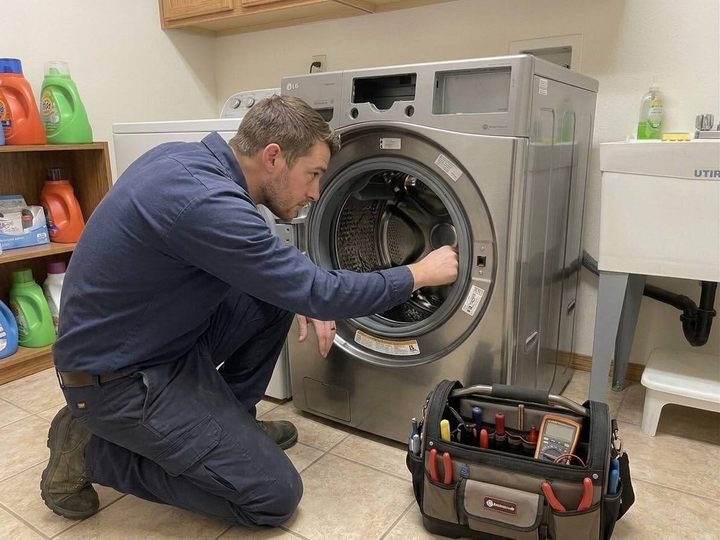
Modern washers keep honest diaries. The visit starts by reading yours — then the meter confirms what the code suspects before any part is named.
A washing machine fails in public — mid-cycle, full of water, often with a code blinking on the panel. The workshop treats that code as the first witness: it's logged, looked up against the service data for your exact model, and then tested, because codes point at circuits, not always at culprits. A drain code with a clean pump reading sends the visit to the trap and hose, not to the parts catalog.
Water gets handled with respect while the diagnosis runs — pumped down properly, never bailed across your floor. When the fault is cornered, the figure goes in writing: labor from the published rate, the part itemized at its own price, the decision entirely yours. Bearing jobs on sealed tubs get the honest arithmetic out loud before any money moves, because some washers deserve the repair and some deserve the truth.
Every machine family keeps favorite complaints. These are the characters this one shows most — and what they usually turn out to mean once the meter weighs in.
A different code on your display? Read it to the workshop — it goes straight into the visit plan.
Panels reset when power blips, and the code is worth more than the symptom. A photo of the display saves ten minutes of reconstruction at the door.
Coins, hairpins and one lost sock cause a startling share of drain calls. The trap catches them — until it fills.
A walking washer is telling you its feet or suspension need attention. Rubber pads under the corners muffle the message without fixing the machine.
The same letters mean different things across nameplates and generations, so the code gets checked against service data for your exact model before it steers anything. A guessed meaning is worse than no code at all.
A machine stopped full gets pumped down properly before diagnosis — hoses to a bucket, floors dry. It costs ten minutes and spares your laundry room; bailing theatrics are not part of the method.
Roar on spin raises the serviceable-or-sealed question, and the answer changes the whole economics of the repair. You hear that arithmetic before any figure is written — including when the honest number favors replacement.
Kill the power at the breaker, then call. Don't force the door; the machine will be pumped down properly at the start of the visit, floors dry, dignity intact.
Usually — and what matters next is whether your tub design is serviceable or sealed, because that detail alone determines if the job makes financial sense. You'll know before any figure is written.
Both, plus the stacked pairs in closets and condos. The instruments travel; the physics doesn't change.
Sometimes the code plus your description rules a visit out — a hose kink you can fix yourself, a breaker that tripped. When that's the case, you'll be told so on the call, free.
One call books the readings; one written figure follows them. The decision after that is entirely yours.