Bellingham's dryers live in basements, garages and second-floor closets — different rooms, same physics. The manometer doesn't care about the neighborhood, and neither does the written figure.
Spread the city's dryer calls on the bench and the instrument tells one story in three accents. Down in the older grid, exhaust pressure readings sag because vent runs wander through crawlspaces that were an afterthought when the laundry moved indoors; up the Meridian corridor and around the newer hills, the runs are short but the terminations clog tight; and in the apartment and condo stock, booster fans and shared chases add variables the nameplate never planned for. The number on the gauge sorts all of it before a single component gets accused — a healthy machine pushing against a dead vent posts a reading no opinion can argue with.
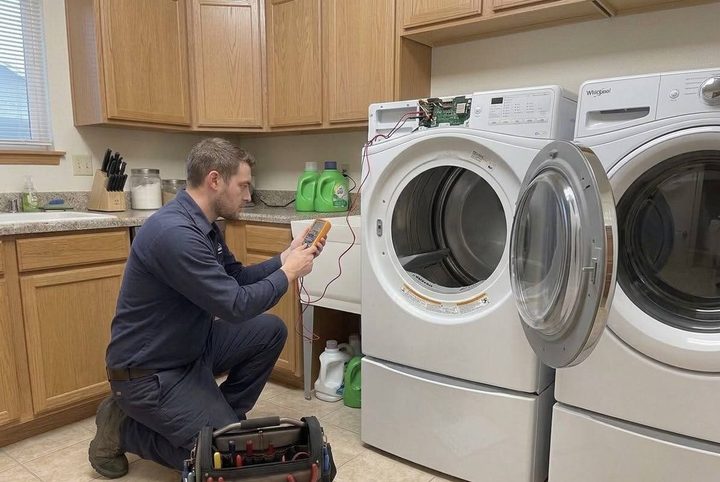
When the pressure clears the vent and the fault sits inside the cabinet, the meter takes over: amp draw across the motor, resistance across elements and thermostats, continuity down the safety chain. The finding lands as one written figure for the labor, with any component itemized on its own signed line — and the machine's age gets a sentence in the conversation, because a heater bank on a young dryer is sensible money while the same part on a spent one deserves a plain word instead of an invoice.
98225, 98226 and 98229 book against the same instruments and the same written-figure arrangement. The workshop sits on E Kellogg Rd, so the north side is minutes and the far lake road is still inside the ordinary rounds.
Wet-season laundry runs heavy citywide, and a vent that limped through August fails in November. Doubled dry times are the city's commonest laundry complaint — and the cheapest reading on the list usually explains them.
Condo and apartment stacks from downtown to the college blocks come out for a proper reading with slim tooling and no drywall drama — noted at booking, handled on arrival.
The whole city rides the book — north side around the workshop, downtown and the south neighborhoods, and out the lake road. The neighborhood pages map the weekly routes, but no Bellingham address sits off them.
The phone narrows it; the manometer settles it. Both get checked in one visit either way, so the answer arrives with a number attached rather than a shrug.
The labor for the diagnosed fix, in writing, before work starts — with any part on its own line at its own price, signed separately. The service visit itself is the flat figure quoted at booking.
One visit, real instruments, a written figure — and a straight word if the machine isn't worth it.